Why Coils Freeze in Tennessee Humidity
It sounds backwards. The house is sticky, the heat index is over 100, and your air conditioner is making ice. Here is the simple version of how that happens: your evaporator coil is supposed to stay just above freezing while warm indoor air flows over it. That airflow keeps the coil warm enough to stay liquid. Take the airflow away, or starve the coil of refrigerant, and the coil temperature drops below 32 degrees. Moisture in the air freezes onto it. The ice blocks more airflow, which makes it colder, which makes more ice. It snowballs fast.
When we get a call about a frozen system in Mount Juliet, the cause is nearly always one of these:
- A dirty filter. The classic. A packed filter cuts return airflow, the coil gets too cold, ice forms. We see this constantly after long stretches where nobody swapped the filter.
- A dirty evaporator coil. Dust blankets the coil fins over the years, insulating them and restricting air. Coil cleaning is a routine pro task.
- Low refrigerant from a leak. Less refrigerant means lower pressure and lower coil temperature. And remember, refrigerant lives in a sealed system, so low charge means it is leaking somewhere.
- A weak or failing blower. If the indoor blower is not moving enough air, the coil ices up even with a clean filter.
- Running the AC when it is cool outside. Spring and fall nights in the 60s with the thermostat cranked low can freeze a coil that would run fine in July.
- Blocked return air or closed vents. Starving the system of return air has the same effect as a dirty filter.
The Safe Thaw Routine, Step by Step
Do this the moment you spot ice on the refrigerant lines or around the indoor unit:
- Turn cooling OFF at the thermostat. Stop the freeze in its tracks.
- Switch the fan to ON. Moving room-temperature air across the coil thaws it much faster than letting it sit.
- Check the filter. If it is clogged, replace it while the system thaws.
- Wait for a full thaw. This takes several hours for a badly frozen coil. Put towels down, because melting ice drips.
- Do not chip, scrape, or poke the ice. Coil fins are thin aluminum and refrigerant lines are soft copper. One slip turns a service call into a coil replacement.
Once everything is melted and dry, you can try cooling again. If it cools fine and never freezes again, a clogged filter may have been the whole story. If ice returns, call us. The root cause is still in there.
What a Technician Actually Checks
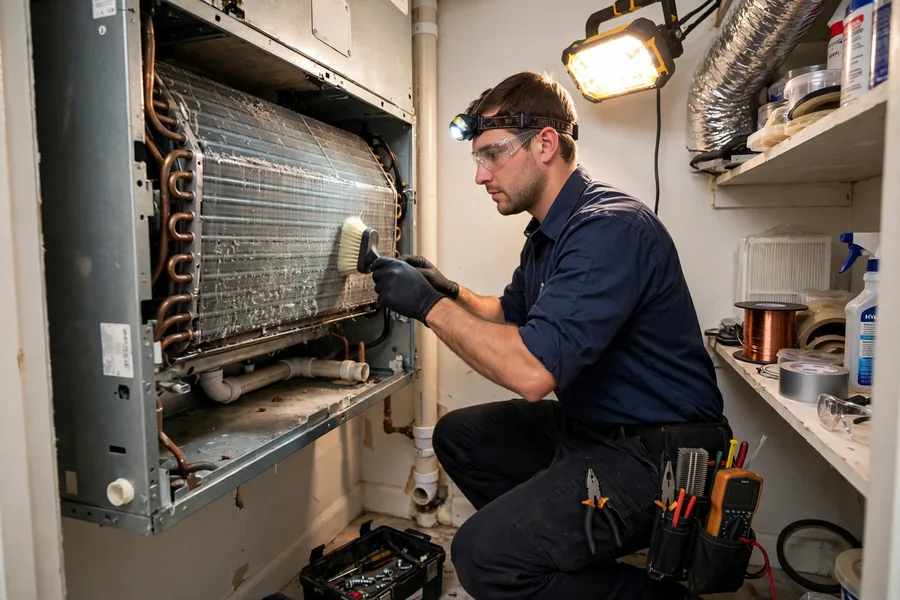
A frozen coil is a symptom, not a diagnosis, so on a typical visit we verify rather than guess. That means measuring static pressure across the coil to confirm airflow is restricted, checking the blower's amp draw against its rating, and reading superheat and subcooling to see whether the refrigerant charge is right for the conditions. If the charge is low, we look for the leak with an electronic detector or nitrogen test before adding a single ounce of refrigerant.
We also look at the duct side. Leaky attic ductwork pulling hot, humid air into the system makes freeze-ups more likely, and a return duct that is undersized for the house will choke airflow no matter how clean the filter is. Those fixes cost more than a filter, but they are the ones that stop the problem for good.
Freeze-Up Causes at a Glance
| Cause | Telltale sign | Fix |
|---|---|---|
| Dirty filter | Weak airflow, ice after months without a change | Replace the filter; thaw and monitor |
| Dirty evaporator coil | Ice returns even with a fresh filter | Professional coil cleaning |
| Low refrigerant | Ice plus hissing, or gradually weakening cooling | Leak repair, then recharge |
| Failing blower | Weak airflow from vents, odd motor noise | Blower motor or capacitor repair |
| Oversized system, short cycling | Cools fast but stays clammy, frequent icing | Load evaluation; may need right-sizing |
Your Questions, Answered
How long does it take a frozen AC to thaw?
Usually several hours for a fully frozen coil. Turn cooling off and switch the fan to ON, which moves room-temperature air across the coil and speeds the thaw. Do not chip or scrape the ice, and do not restart cooling until the ice is completely gone and airflow is restored.
Can I keep running my AC if it is frozen?
No. Running a frozen system can slug liquid refrigerant back to the compressor, and compressors are built to pump vapor, not liquid. A short run while you notice the problem will not destroy it, but continuing to run it risks turning a cheap fix into a compressor replacement.
Why does the ice keep coming back after it thaws?
Because thawing treats the symptom, not the cause. If ice returns, the underlying problem is still there: usually a dirty filter, a blower issue, low refrigerant from a leak, or ductwork restricting airflow. A technician needs to find which one it is before the next freeze-up.
Is a little frost on the outside pipe normal?
A light, even frost on the suction line that melts off quickly can be normal on a humid day. A thick coat of ice, or ice on the coil and indoor lines that does not melt, is not normal and means the system needs attention.
Does Tennessee humidity cause AC freeze-ups?
Humidity does not directly freeze a coil, but it sets the stage. With humidity in the 70s and heat indexes over 100, systems run long cycles with heavy moisture loads. When airflow is restricted or refrigerant is low, those long run times give the coil more opportunity to drop below freezing and ice over.
Frozen Coil? We Will Get It Thawed and Fixed.
Call now and we will walk you through the safe thaw, then schedule a visit to fix what caused it. Most freeze-ups are resolved in a single appointment.
24/7 emergency service · Same-day appointments · Upfront pricing