The 10-Minute Pre-Call Checklist
Work these in order. Each one rules out a common no-start cause, and none of them asks you to open an electrical panel or touch wiring.
- Thermostat. Set to COOL, setpoint several degrees below room temperature, fan on AUTO. If the screen is blank, try fresh batteries. A dark hardwired thermostat means the indoor unit lost power, which points you to the next step.
- Breaker panel. Find the breakers labeled for the AC, air handler, and furnace. If one tripped, reset it exactly once. If it trips again, stop. A breaker that will not stay on is warning you about a compressor or motor problem.
- Condensate drain switch. Look for a small float switch on the drain line or pan under the indoor unit. If the drain clogged, water rises and the switch kills power to protect your ceiling. You can lower the float or clear a visible clog, but a line that keeps backing up needs professional clearing.
- Outdoor disconnect. There is a shutoff box near the condenser unit outside. Make sure it is in the ON position. Storms and yard work knock these off more often than you would think.
- Ice check. Look at the refrigerant lines at the indoor unit. If they are iced over, the system may be shutting itself down on a safety limit. Turn cooling off, fan to ON, and let it thaw before restarting.
If the system starts after any of these, you probably just saved yourself a service call. If it starts and then dies again, note exactly what happened. That pattern is useful information for the tech.
What NOT to Do
This is the part that keeps people safe. The inside of an air conditioner is not a place for trial and error:
- Do not keep resetting a tripped breaker. One reset is troubleshooting. Repeated resets are asking a failing component to destroy itself, and possibly the wiring with it.
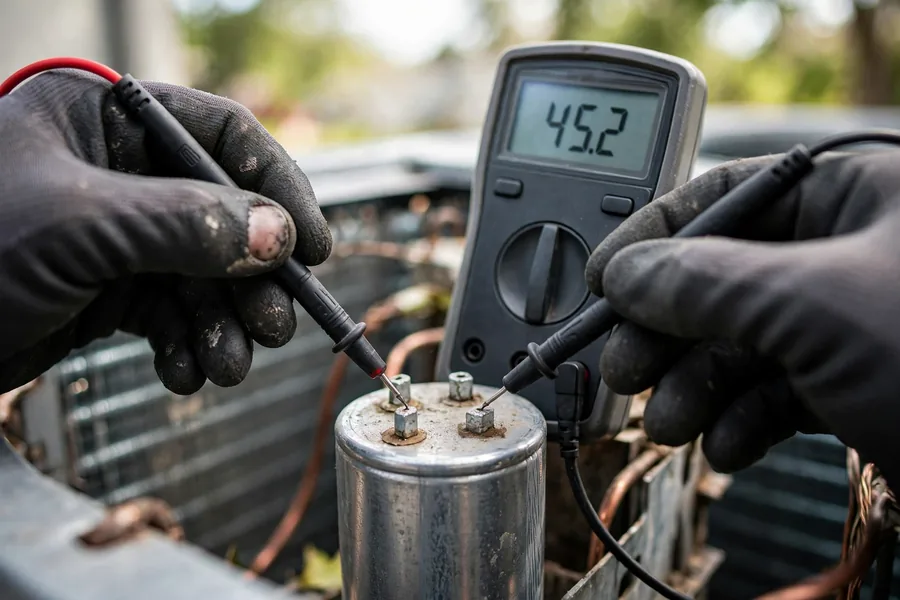
- Do not open the electrical panel on the unit. Capacitors hold a 240-volt charge even with the power off. That is the single most dangerous part of an AC, and why capacitor replacement is pro-only work.
- Do not bypass safety switches. The drain float switch, high-pressure switch, and limit switches exist to prevent water damage, compressor failure, and worse. Jumping them out to force a start can turn a small repair into a ruined system.
- Do not add refrigerant yourself. Federal rules require proper handling, and without gauges you cannot know the charge anyway. Guessing with refrigerant damages compressors.
A lot of the viral DIY advice floating around skips the why behind these warnings. The why is simple: 240 volts can stop your heart, refrigerant can blind you and wreck a compressor, and combustion equipment has its own separate set of dangers. The checklist above is the safe line. Everything past it is ours.
Reading the Clues: What Each Pattern Means
When we get a no-start call, the first thing we ask is what the system is doing, because the pattern usually names the culprit before we open anything:
| What you see and hear | Likely cause |
|---|---|
| Nothing at all, thermostat blank | No power to indoor unit: breaker, drain switch, or transformer |
| Thermostat clicks, indoor fan runs, outdoor unit silent | Outdoor breaker, disconnect, capacitor, or contactor |
| Outdoor unit hums but fan does not spin | Failed fan capacitor or motor |
| Starts, runs a few minutes, shuts off | Frozen coil, safety limit, or overheating compressor |
| Dead right after a storm or outage | Tripped breaker or surge damage to the control board |
When to Stop Troubleshooting and Call
Call us right away if the breaker trips more than once, if you smell burning or see scorch marks, if water is leaking from the indoor unit, or if the checklist got you nowhere after ten minutes. That is what 24/7 service is for. On a typical no-start visit we check voltage at each stage, test the capacitor and contactor, verify the drain switch and safeties, and confirm the thermostat signal is actually reaching the equipment. Most no-start calls are diagnosed and fixed in one trip.
Your Questions, Answered
My thermostat screen is blank. What does that mean?
A blank thermostat usually means it has no power. Start with fresh batteries if it uses them. If it is hardwired and the screen is dark, the indoor unit may have lost power: check the breaker and the condensate drain float switch, which cuts power to the thermostat when the drain pan fills. If the breaker is on and the screen stays blank, call a technician.
My AC breaker tripped. Can I just flip it back on?
Once, yes. A single reset after a storm or power blip is reasonable. If it trips again, stop resetting it. A breaker that will not stay on is protecting you from a real problem, usually a compressor or motor drawing too much current. Repeated resets risk turning a motor repair into a burned-out compressor.
The indoor fan runs but the outdoor unit will not start. Why?
The outdoor unit has its own power path and start components. The most common causes are a tripped outdoor breaker or disconnect, a failed capacitor, or a failed contactor. Capacitors and contactors are pro-only work because of the 240-volt charge stored in the circuit. Check the disconnect and breaker, then call us.
What is the condensate drain switch and where is it?
It is a small float switch mounted on the condensate drain line or the drain pan under your indoor unit. When the drain clogs, water rises, the float lifts, and the switch shuts the system down to prevent a ceiling leak. You can safely lower the float or clear the visible clog, but if the line keeps backing up, the drain needs a professional clearing.
My AC will not start after a power outage. Is it broken?
Not necessarily. Many thermostats and systems have a built-in compressor delay of about five minutes after power returns, to protect the compressor from restarting too soon. Wait a full five to ten minutes with the thermostat set to cool. If it still will not start, check the breaker, since surges commonly trip it. Persistent failure after an outage can mean surge damage to the control board, which needs a technician.
Checklist Did Not Fix It? That Is What We Are For.
Call now and tell us what the system is doing. We will diagnose it in one visit and give you straight options before any work starts.
24/7 emergency service · Same-day appointments · No-pressure options