The Straight Answer for Middle Tennessee
Some climates let you get away with once a year. This is not one of them. A Nashville-area summer runs from June deep into September with highs near 89°F, humidity in the 70s, and heat indexes routinely over 100°F. Then winter shows up with January lows near 27°F and the occasional ice storm. That is two full seasons of heavy equipment runtime, which is why the honest cadence here is a spring cooling visit and a fall heating visit.
The spring visit preps the air conditioner: clean the condenser and evaporator coils, verify the refrigerant charge, test the capacitor and contactor, clear the condensate drain, check airflow and static pressure, and calibrate the thermostat. The fall visit does the same job for the heating side: heat exchanger inspection, combustion safety check on gas furnaces, heat pump defrost and auxiliary heat verification, and another look at the electrical components that wear all year.
What Skipping It Actually Costs You
Nobody is saying your system explodes the month you skip a tune-up. What happens is slower and quieter. A coil slowly cakes with dust, so the system runs twenty minutes longer each cycle. A capacitor weakens, so the compressor strains on every start. A drain line grows algae until it clogs and the float switch kills the whole system on the hottest Saturday of the year. By the time something breaks, it has usually been degrading for a season or two.
There are three costs that matter:
- Higher bills. A neglected system uses more electricity to deliver the same cooling. Dirty coils and incorrect charge are the usual suspects.
- Shorter equipment life. Compressors and motors that run hot and strained die younger. Maintenance is the cheapest life extension a system gets.
- Warranty risk. Many manufacturers require documented professional maintenance. No records, no warranty coverage when the compressor fails in year seven.
We see the pattern every summer in neighborhoods like Willoughby Station, where late-90s and early-2000s systems are deep into their second decade. The houses that get regular tune-ups limp along comfortably. The ones that do not are the ones calling us at 9 p.m. in August.
What a Real Tune-Up Includes
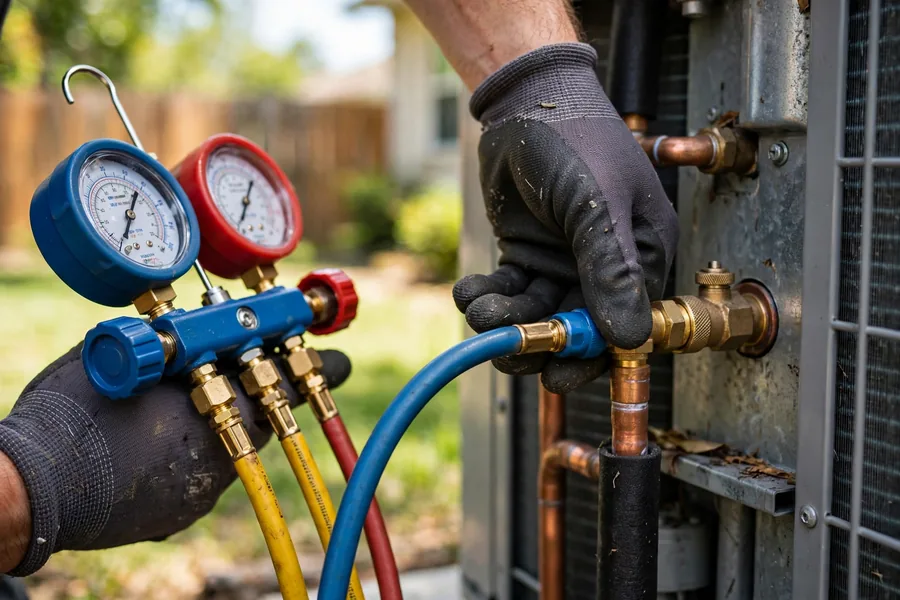
A legitimate tune-up is a checklist, not a glance. On a typical cooling visit we check refrigerant pressures and verify charge with superheat and subcooling readings, test capacitors and contactors under load, clean the outdoor condenser coil, inspect the indoor evaporator coil, flush and treat the condensate drain, measure temperature split across the coil, verify thermostat calibration, and check overall airflow. If something is wearing out, we show you the part and explain your options. No pressure, no mystery.
That last sentence matters more than it sounds. The $49 tune-up offers floating around town are often designed to get a salesperson in your door, not a technician. A real tune-up takes an hour or more and ends with information, not a hard close.
Your Year at a Glance
| When | Visit | What gets checked |
|---|---|---|
| March to May | Spring cooling tune-up | Coils, refrigerant charge, capacitor, contactor, drain line, airflow, thermostat |
| Monthly, June to September | Your own filter check | Hold the filter to a light; replace when you cannot see through it |
| September to November | Fall heating tune-up | Heat exchanger, combustion safety, heat pump defrost, auxiliary heat, electrical |
| Year-round | Keep the outdoor unit clear | Two feet of clearance; rinse grass and debris off the condenser coil |
Your Questions, Answered
Is once-a-year maintenance enough for my AC?
In Middle Tennessee, we recommend twice a year: a cooling check in spring and a heating check in fall. Systems here run hard on both ends, with long humid summers and real winter cold snaps. Once a year is better than nothing, but it leaves half the system unchecked.
Will regular maintenance actually lower my energy bills?
It usually does. A dirty coil, low refrigerant charge, or failing capacitor forces the system to run longer and draw more power to do the same work. Cleaning and calibration restore the efficiency the system was designed for. Savings vary by system condition, but neglected systems consistently cost more to run.
Does skipping maintenance void my warranty?
It can. Many equipment manufacturers require documented professional maintenance to keep the parts warranty valid. If a compressor fails and there is no maintenance record, the warranty claim can be denied. Keep your tune-up invoices with your equipment paperwork.
Are those $49 tune-up offers a good deal?
Be cautious. Ultra-cheap tune-ups are often lead generators: the real business is finding something expensive to sell you once the tech is in the door. A legitimate tune-up takes real time, a real checklist, and a technician, not a salesperson. Ask what is included before you book, and be wary of anyone who finds a failing system on every single visit.
How long does a tune-up take?
A thorough tune-up takes about 60 to 90 minutes per system. If someone is in and out in 15 minutes, they did not do a tune-up. Expect the tech to check refrigerant levels, electrical components, coils, the drain line, airflow, and thermostat calibration, and to show you anything they find.
Due for a Tune-Up? Book the Spring Visit Now.
Beat the summer rush. One visit now means a clean, checked, calibrated system when the heat index climbs past 100.
Mon–Fri 7AM–7PM · Sat 8AM–4PM · 24/7 emergency service