Where the Filter Lives
Your filter sits on the return side of the system, catching dust before it reaches the equipment. In most Mount Juliet homes you will find it in one of three places:
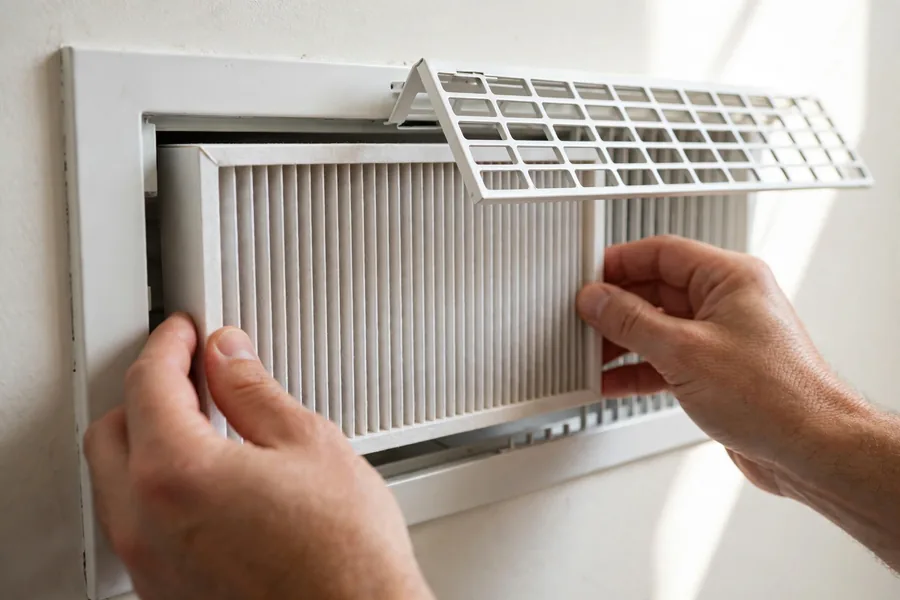
- A return grille in the wall or ceiling. Look for a large vent, often in a hallway or central room, with hinges or latches. The filter sits right behind the grille door. This is the most common setup in single-story and two-story homes alike.
- A slot at the indoor air handler. If the system lives in a closet, garage, or crawlspace, the filter usually slides into a slot on the unit itself, often marked with an arrow.
- A filter cabinet at an attic air handler. Many local homes have the air handler in the attic. The cabinet is a wider box attached to the unit, holding a thicker 4-inch media filter. Bring a flashlight and watch your step up there.
Turn the system off at the thermostat before you start. It keeps dust from getting pulled in while the slot is open, and it is just good practice.
The Five-Minute Swap
- Pull the old filter. Note the size printed on the frame, like 20x25x1, and the direction of the airflow arrow.
- Buy the same size. Match the dimensions and the MERV rating, or close to it. When in doubt, MERV 8 in a 1-inch filter is the safe default for most systems.
- Slide the new filter in. Arrow pointing toward the blower, in the direction of airflow. At a return grille, that means away from the room. At the air handler, into the unit.
- Close everything up and restart. Grille door latched, cabinet closed, thermostat back on. Done.
Filters are sized in nominal dimensions, which run about a half inch under the printed number. A filter labeled 20x25x1 actually measures around 19.5 by 24.5 inches. That is normal, not a defect.
The MERV Mistake That Chokes Airflow
MERV ratings run from 1 to 16, and higher numbers catch smaller particles. It is tempting to buy the highest number on the shelf. Resist the urge, because the denser the filter, the harder your blower works to pull air through it. On a system designed for a basic filter, a MERV 13 in a 1-inch slot raises static pressure, starves the evaporator coil of air, and can freeze the coil solid. We have been on plenty of no-cooling calls where the whole problem was a well-meaning filter upgrade.
The rule is simple: match what the system was designed for, and if you want hospital-grade filtration, ask about a 4-inch media filter cabinet instead. The extra depth gives you high MERV with much lower restriction.
How Often to Swap in Tennessee
The box says every 90 days. Reality depends on your house:
| Your situation | Check every | Typical MERV |
|---|---|---|
| No pets, no allergies | Every 2 to 3 months | MERV 8 |
| One pet or mild allergies | Every 1 to 2 months | MERV 8 |
| Multiple pets, kids, heavy pollen season | Monthly in summer | MERV 8 to 11 |
| 4-inch media filter cabinet | Every 3 to 6 months | MERV 11 to 13 |
The light test never lies. Hold the used filter up to a light. If you cannot see light through it, it was overdue, whatever the calendar said.
Your Questions, Answered
Which way does the arrow on the filter point?
Toward the blower, which means in the direction of airflow. In a return grille, the arrow points into the duct, away from the room. At the air handler, the arrow points into the unit. If you are unsure, the old filter's arrow shows you the way before you pull it out.
Can I use a higher MERV filter for better air quality?
Not always. Higher MERV filters catch smaller particles, but they also restrict airflow more. On many residential systems, jumping to a MERV 13 in a 1-inch slot chokes airflow, raises static pressure, and can freeze the coil. MERV 8 is the safe default for most 1-inch filters. For serious filtration, ask about a 4-inch media filter cabinet, which gives high MERV with low restriction.
What size filter do I need if the old one is missing?
Measure the filter slot itself: length, width, and depth. Filters are sold in nominal sizes that run about a half inch under the listed dimensions, so a slot measuring roughly 19.5 by 24.5 inches takes a nominal 20x25 filter. Take a photo of the slot and the model plate on the air handler to the store with you.
What is the difference between 1-inch and 4-inch filters?
A 4-inch media filter has far more surface area, so it lasts three to six months, catches more, and restricts airflow less than a 1-inch pleated filter at the same MERV rating. They fit in a dedicated filter cabinet at the air handler. If your home has chronic dust or allergy trouble, a media cabinet is worth asking your tech about.
Why does my brand-new filter turn gray in a month?
A filter that loads up fast is doing its job, but it can also be a clue. Homes with pets, construction dust, or leaky return ductwork pulling dirty attic air will burn through filters quickly. If every filter is black within weeks, have the ductwork checked for leaks, because the filter should not be cleaning your attic.
Filter Is Fresh and It Still Won’t Cool?
Then the problem is deeper than the filter. Call us and we will find it, explain it plainly, and fix it in one visit whenever we can.
Same-day service · Upfront, itemized pricing · 24/7 emergency help