Why Mount Juliet Storms Are an HVAC Problem
Nobody in this town needs convincing that storms are real. On March 3, 2020, an EF3 tornado tore through Mt. Juliet, destroying hundreds of homes and leveling West Wilson Middle School and Stoner Creek Elementary. Five people died. Beyond the headline disasters, spring and fall bring regular rounds of severe thunderstorms, and with them come power outages and the voltage surges that ride in on flickering lines.
The local climate makes surge damage hit harder here. The City Between the Lakes sits between Old Hickory Lake to the north and Percy Priest Lake to the south, and that humidity means July highs near 89°F with humidity in the 70s and heat indexes over 100°F. Systems run long, heavy cycles all summer. A fried control board in April is an inconvenience. The same failure in August, with the house climbing toward the high 80s indoors, is an emergency. That is why storm protection belongs on the same list as filter changes for local homeowners.
How Surges Actually Damage Your System
A surge is a brief spike of voltage, far above the 240 volts your outdoor unit expects. Modern HVAC equipment is full of sensitive electronics, so the damage follows a predictable order:
- Control boards first. The circuit boards in the air handler and condenser are the most surge-sensitive parts in the system. A strong spike can burn traces right off the board.
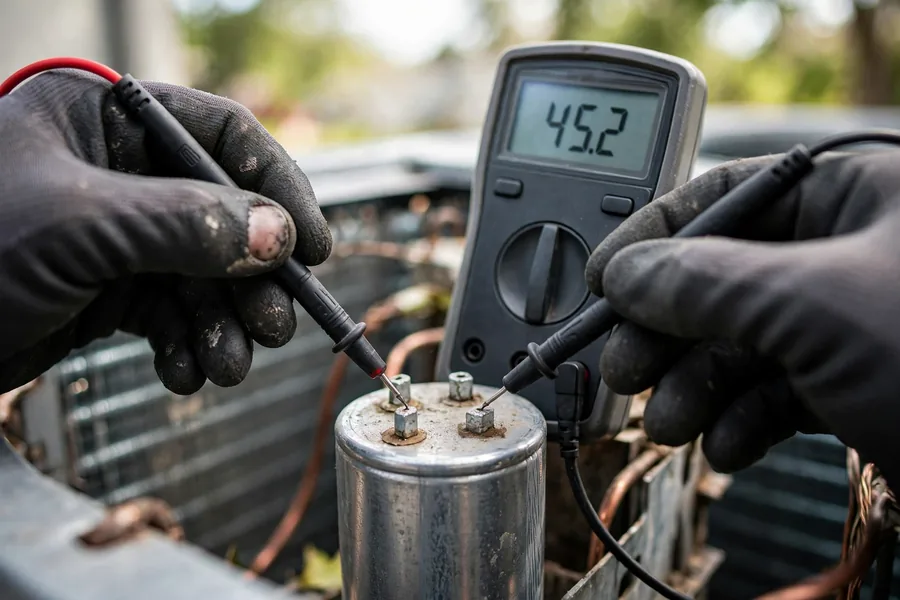
- Capacitors next. Start and run capacitors already live hard lives in Tennessee heat. A surge can finish off a weakened one instantly.
- Thermostats. Smart thermostats and their low-voltage wiring are vulnerable. A dead thermostat after a storm is a classic surge signature.
- Compressors on restart. If power flickers and the compressor tries to restart against unequalized pressure, it draws a huge inrush current. That is why the five-minute delay matters.
- Blower and fan motors. Less common, but a severe spike can take out motor windings too.
Lightning does not have to hit your house. A strike blocks away can push a surge through the utility lines, and the spike arrives at your panel in milliseconds. The system does not have to be running to be damaged, which is why surge protection is about the wiring, not the thermostat setting.
After the Power Comes Back: The Five-Minute Check
- Wait five to ten minutes. Let the grid stabilize and the compressor pressures equalize before anything restarts.
- Check the thermostat. If the screen is lit and responsive, the low-voltage side survived.
- Check the breakers. Surges trip breakers. Reset any tripped AC breaker exactly once.
- Restart in COOL. Set the thermostat a few degrees below room temperature and listen for the outdoor unit.
- Watch for wrong behavior. Humming without starting, immediate shutdown, error codes, or a burning smell all mean stop and call.
If the outdoor unit hums but the fan does not spin, the surge likely took the capacitor. Do not keep trying to force it. Call us and we will test the start components and the board.
Surge Symptoms at a Glance
| Symptom | Likely cause | Your move |
|---|---|---|
| Thermostat screen is dead | Surge killed the thermostat or its transformer | Check breaker once, then call |
| Breaker tripped after the outage | Surge or inrush current on restart | Reset once; if it trips again, stop and call |
| Outdoor unit hums but will not start | Failed capacitor from the surge | Do not force it; call a tech |
| System runs but behaves erratically | Damaged control board | Call; boards need professional diagnosis |
| Burning smell from the unit | Burned wiring or board | Shut it off and call immediately |
Protection Worth Having
The single best defense is a surge protector installed at the electrical panel or at the outdoor disconnect. It absorbs the spike before it reaches the equipment, and it protects every circuit in the house, not just the AC. It is pro-installed equipment, wired into the panel, and it costs a fraction of a control board replacement. In a town where severe storms are a spring and fall tradition, it is one of the easiest yeses in homeownership.
A few more habits that help: turn the system off at the thermostat ahead of a severe storm, keep the area around the outdoor unit clear so wind-driven debris does not damage the coil, and after any major storm, do the five-minute check before assuming all is well. If your home relies on a generator during outages, make sure it is sized and transferred properly, because dirty generator power can be as hard on electronics as a surge.
Your Questions, Answered
Can a power outage damage my air conditioner?
The outage itself usually does not, but the moments around it can. When power flickers or returns, voltage surges can fry control boards and capacitors, and a compressor that restarts too quickly after a brownout can overheat. Waiting a few minutes before restarting and checking the breaker covers most cases.
Why will my AC not start after a storm?
The most common reasons are a tripped breaker, which surges often cause, or the system's built-in compressor delay, which needs about five minutes after power returns. Check the breaker once and give it ten minutes. If it still will not start, the surge may have damaged the control board or capacitor, which needs a technician.
Is a whole-home surge protector worth it for my HVAC?
For most homes in storm-prone Middle Tennessee, yes. A professionally installed surge protector at the panel or disconnect absorbs the voltage spikes that kill control boards and capacitors. It is far cheaper than replacing a fried board, and it protects everything else in the house too.
Can lightning damage my HVAC even if the power stayed on?
Yes. Surges travel through power lines, phone lines, and even the ground, so a nearby strike can send a spike through the wiring while the lights stay on. If the system acts strangely after a close strike, dead thermostat, erratic behavior, or a unit that will not start, have it checked even though the power never dropped.
Should I turn my AC off during a thunderstorm?
It is a reasonable precaution for a severe storm. Turning the system off at the thermostat, or the disconnect if the storm is severe, removes it from the surge path. Just remember that most systems need a few minutes before restarting so the compressor pressures can equalize.
Storm Damage? We Will Get You Back Up.
Surge damage, dead thermostats, units that will not restart: we diagnose it in one visit and fix most of it the same day. Call now, day or night.
24/7 emergency service · Same-day appointments · Upfront, itemized pricing