Troubleshooting Guide
Common Air Conditioner Problems in Mount Juliet Homes
"Not cooling" can mean four different things, and each one points a different direction. Here's how to read what your system is telling you.
Honest DIY-vs-pro advice · No upsell bait · Same-day visits
Start Here: What Does "Not Cooling" Actually Mean?
When Mount Juliet homeowners call us saying the AC isn't cooling, we ask one question first: what's it actually doing? The answer falls into four buckets, and each sends us down a different diagnostic path.
- Not running at all. Nothing responds: no indoor fan, no outdoor hum. Usually electrical: thermostat, breaker, disconnect, or a safety switch.
- Running but blowing warm air. The indoor fan works but the air isn't cold. Often a frozen coil, low refrigerant, or the outdoor unit isn't running.
- Cooling downstairs but not upstairs. The system works, but comfort doesn't reach the second floor. Typically duct design, return-air path, or insulation issues in two-story homes.
- Fine in the morning, losing ground by late afternoon. The system keeps up until the heat-index peaks, then the house creeps up. Can mean an undersized or aging system, duct leakage, or declining refrigerant charge.
Match your symptom to the bucket before you start guessing at parts. It saves you time and saves us a step when you call.
The Problems We See Most in Wilson County
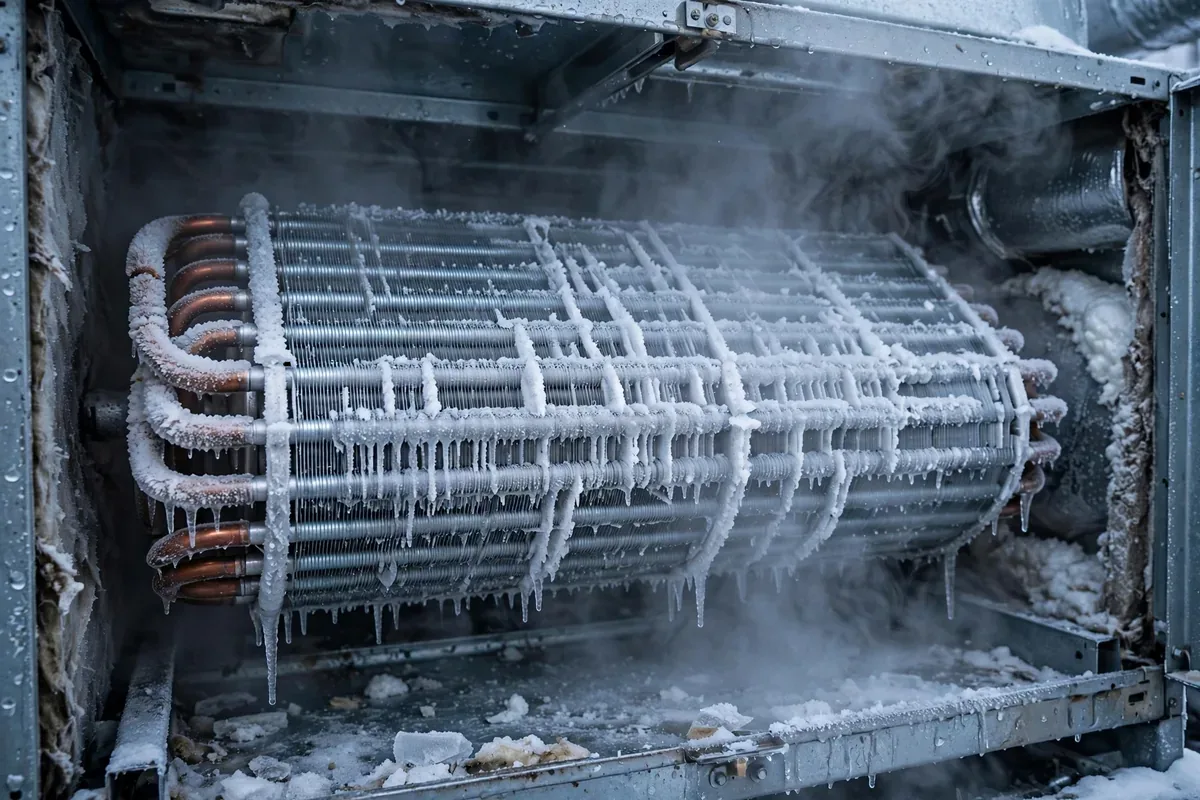
Frozen evaporator coil
Ice on the refrigerant lines or the indoor coil is the classic Middle Tennessee failure, especially on 90-plus-degree days. It starts with restricted airflow: a clogged filter, a matted evaporator coil, or a weak blower, and once ice forms it only gets worse. If you see ice, turn cooling off (leave the fan on to thaw), swap the filter, and don't restart cooling until it's fully defrosted and a tech has found the cause.
Low refrigerant from a leak
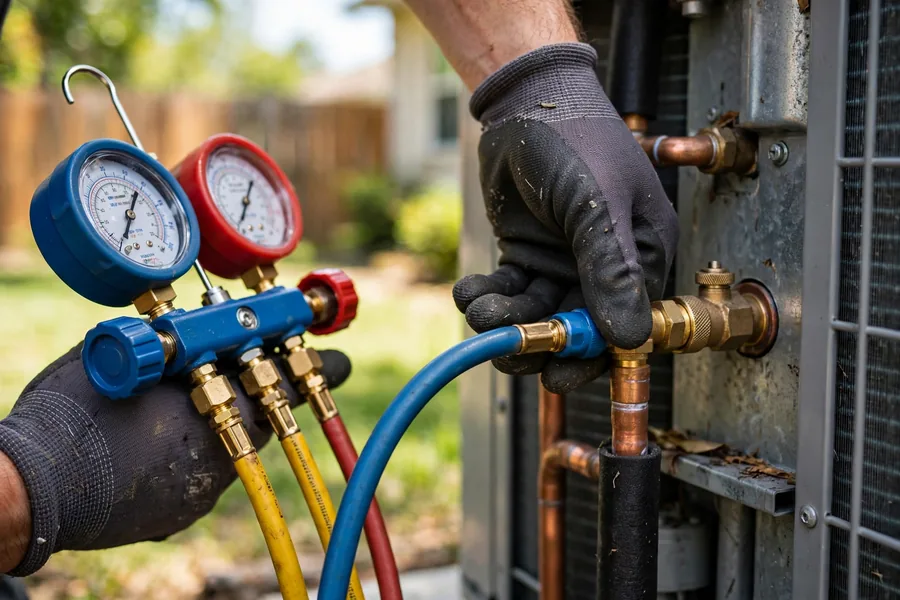
Here's the myth that costs people money: refrigerant is not "used up." It runs in a sealed loop, so a low charge means there's a leak. A top-off without a leak repair will have you calling again in weeks. The right fix is locating the leak (nitrogen pressure test, electronic detection), repairing it, and recharging to the manufacturer's spec, verified with superheat and subcooling readings.
Failed capacitor or contactor
The two most common electrical failures we find. A capacitor is the little cylinder that helps motors start and run; when it bulges or fails, the fan or compressor hums but won't start. A contactor is the switch that feeds power to the outdoor unit; when its contacts burn, the unit won't engage. Both are same-visit fixes, and this is exactly the failure behind those stories of $16,000 replacement quotes for a part that costs a fraction of that.
Clogged condensate drain
Your AC pulls gallons of moisture from humid Tennessee air every day, and it all drains through a small line. When algae and sludge clog it, water backs up, trips the float switch (system shuts off, which is maddening), or overflows into the ceiling. A wet spot near the air handler or a system that runs then suddenly quits are the telltales.
Thermostat and control issues
Dead batteries, a thermostat set to "heat" instead of "cool," a schedule that changed itself after a power blip. We see all of it after spring and fall storm outages. Before you call, check the mode, the setpoint (below room temp), and the batteries. It takes sixty seconds and fixes a surprising number of "emergencies."
Duct leakage and airflow problems
Invisible duct leaks in a hot attic pull superheated air into the system and dump your cooled air where nobody lives. Symptoms: one or two rooms that never keep up, rising bills with no lifestyle change, and dusty supply vents. A duct inspection with static pressure readings tells the truth that a visual check can't.
Symptom Decoder: What You Can Try vs. What Needs a Tech
Some of this is safe homeowner territory. Some of it involves 240 volts, sealed refrigerant circuits, or combustion, and that's pro-only work. The boundary matters.
| Symptom | Likely cause | Your move |
|---|---|---|
| Warm air, weak airflow | Clogged filter or frozen coil | Check and replace the filter; thaw ice before calling |
| System won't start | Thermostat, breaker, or safety switch | Check thermostat settings and the breaker once |
| Breaker trips repeatedly | Short, seized motor, bad wiring | Call a pro; don't keep resetting it |
| Hissing or bubbling near lines | Refrigerant leak | Call a pro: certified handling required |
| Burning smell or scorch marks | Overheating motor or wiring | Shut it down, call immediately |
| Water pooling at the air handler | Clogged condensate drain | Wet/dry vac on the drain's outside end is safe; full cleanout is pro work |
| One hot room | Duct leakage, damper, or return issue | Check that the vent is open; the rest needs a duct inspection |
A Word on Second Opinions
If another company told you the compressor is dead and you need a full system, pause. We've re-diagnosed enough of those quotes to know that a bulged capacitor, a seized contactor, or a refrigerant leak can be dressed up as a $16,000 problem. Bring us the quote and we'll verify the diagnosis with fresh eyes before you spend a dollar. Sometimes replacement really is the right call; we'll tell you that too, and show you why.
Related Reading
Your Questions, Answered
Why is my AC running but not cooling my Mount Juliet home?
The most common causes are a clogged air filter starving the system of airflow, a frozen evaporator coil, a tripped breaker to the outdoor unit, or low refrigerant from a leak. Check the thermostat setting, the filter, and whether the outdoor unit is running. If the lines are iced up, turn cooling off and let it thaw before calling.
Is it safe to keep running my AC if the lines are frozen?
No. Running a system with a frozen coil can slug liquid refrigerant back to the compressor and cause serious damage. Switch the thermostat to OFF (or FAN ON to speed thawing), check the filter, and call a technician to find the cause before restarting cooling.
What does it mean if my AC smells like burning?
A burning smell or visible scorch marks mean something is overheating, often a motor, wiring, or electrical component. Turn the system off at the thermostat and the breaker, and call a technician. Do not keep running it to see if the smell goes away.
Why does my AC keep tripping the breaker?
A tripped breaker is usually a symptom, not the problem. Overloaded circuits, a failing compressor or capacitor, a grounded wire, or a seized motor can all pull excess current. If the breaker trips more than once, stop resetting it and have the system checked; repeated resets can damage the equipment or wiring.
Can I fix a refrigerant leak myself?
No. Refrigerant handling is legally restricted to certified technicians, and finding a leak takes nitrogen pressure testing and electronic detection equipment. Just topping off the charge without fixing the leak means you'll be paying for another top-off in weeks or months.
Not Sure What's Wrong? That's What We're For.
Describe the symptom, we'll diagnose the cause and show you before we fix anything.
CALL NOW · (615) 706-3036